
House Schedules Fiscal Responsibility for December 5, Safely After Midterms
A fictional dispatch inspired by an unusually early stopgap vote, where the one deadline Congress can meet is the one placed safely beyond Election Day.
Source material reviewed July 22, 2026
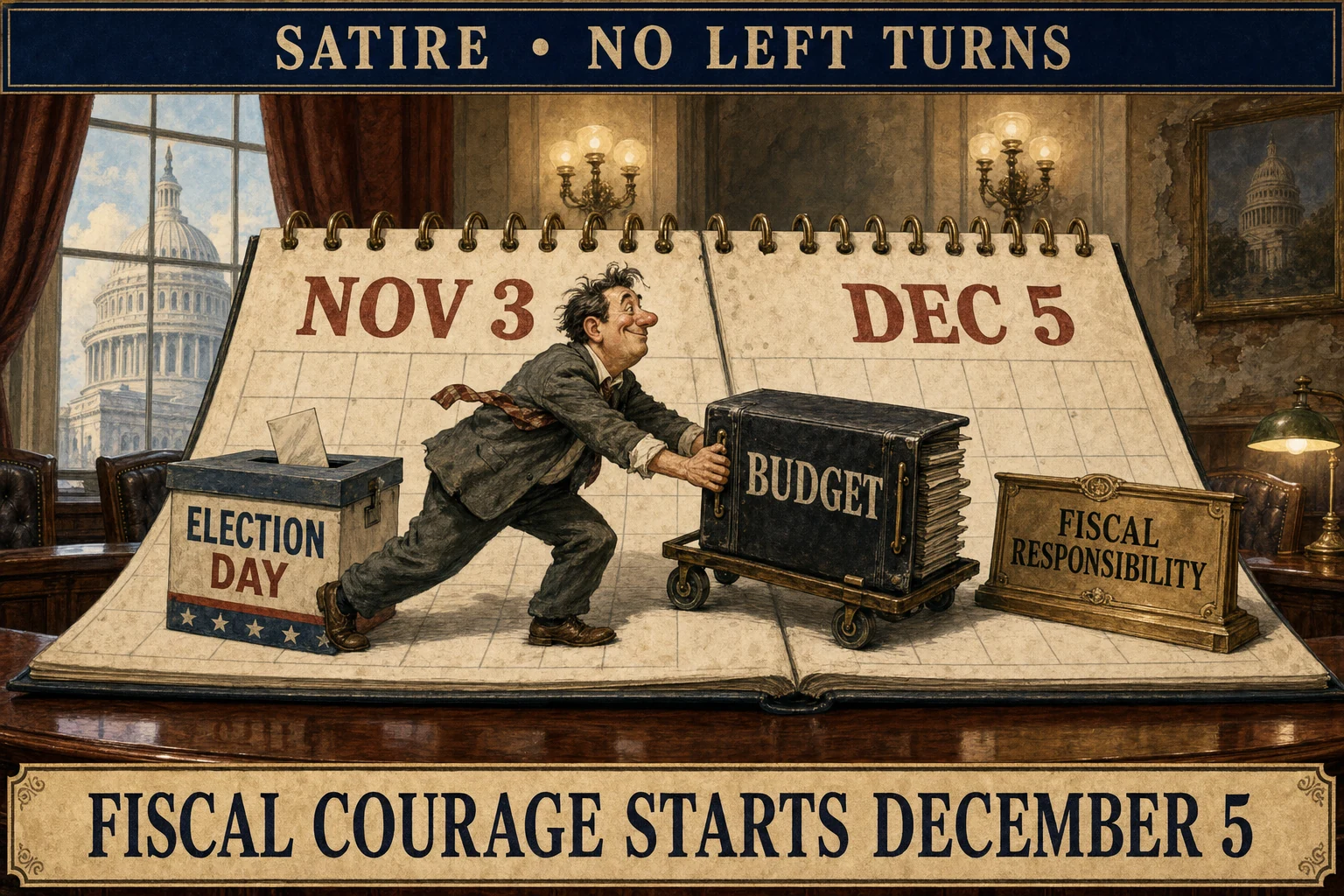
WASHINGTON—Fresh from passing a stopgap bill that would keep the government funded through December 4, the House announced Tuesday that fiscal responsibility will begin promptly on December 5—just 32 days after voters finish deciding whether the current members deserve to keep their jobs.
Leadership aides hailed the calendar as a landmark in congressional planning. Previous generations waited until hours before a shutdown to postpone difficult decisions. This Congress, they noted, had the foresight to postpone them months in advance.
A fictional leadership spokesperson said the arrangement strikes the ideal balance between responsibility and self-preservation. “The American people deserve certainty,” the spokesperson explained, “and incumbents deserve the certainty of not having to explain a funding crisis while standing next to a campaign banner.”
The measure is officially known as H.R. 9770, a continuing resolution. Capitol linguists clarified that “continuing” refers to the spending, while “resolution” describes the determination with which every unresolved question is carried into the next deadline.
Under the new congressional calendar, July is for passing temporary funding early, August is for leaving town, September is for declaring the crisis avoided, October is for campaigning on responsible governance, November is for counting votes, and December is for remembering that twelve annual appropriations bills still exist.
The fictional Office of Convenient Timing projected that the plan will preserve 100 percent of Congress’s available political courage until after campaign season. Any unused courage may be rolled over into the next continuing resolution, subject to appropriations.
Members of both parties claimed partial victory. One side said it had protected the government from a shutdown. The other said it had protected voters from a bad funding bill. Everyone agreed that Congress had successfully protected Congress from several weeks of awkward questions.
Lawmakers are now considering whether to make the innovation permanent. A draft rule would require all future fiscal cliffs, debt-limit showdowns, ethics inquiries, and unpopular votes to occur during the brief democratic dead zone between Election Day and the arrival of the new Congress.
At press time, the Senate was preparing amendments to ensure the December deadline remains both temporary and permanent, depending on which chamber is speaking and whether the cameras are on.
Names, statements, and scenarios may be exaggerated or invented for comedic effect. This article is not factual reporting.
The real setup
Reality behind the satire
The jokes, quotations, and scenarios are fictional. The timing is not. These links document the House vote, the December 4 funding deadline, and the election-season context.
- House Passes H.R. 9770: Providing Certainty, Preventing Disruption, and Advancing Responsible GovernanceHouse Committee on Appropriations · July 21, 2026
- Roll Call 272 | Bill Number: H.R. 9770Office of the Clerk, U.S. House of Representatives · July 21, 2026
- House Passes Temporary Government Funding Bill Months Early to Avoid Election Season ShutdownAssociated Press · July 21, 2026
- Funding Extension Passes House, Heads for Senate RewriteRoll Call · July 21, 2026