
The SAVE America Act: Securing America’s Elections for American Citizens
America’s elections are the foundation of our republic. They determine who writes our laws, who commands our military, who controls our borders, and who shapes the future for our children. For that system to retain legitimacy, only one group of people may participate in federal elections: citizens of the United States.
Sources reviewed July 21, 2026
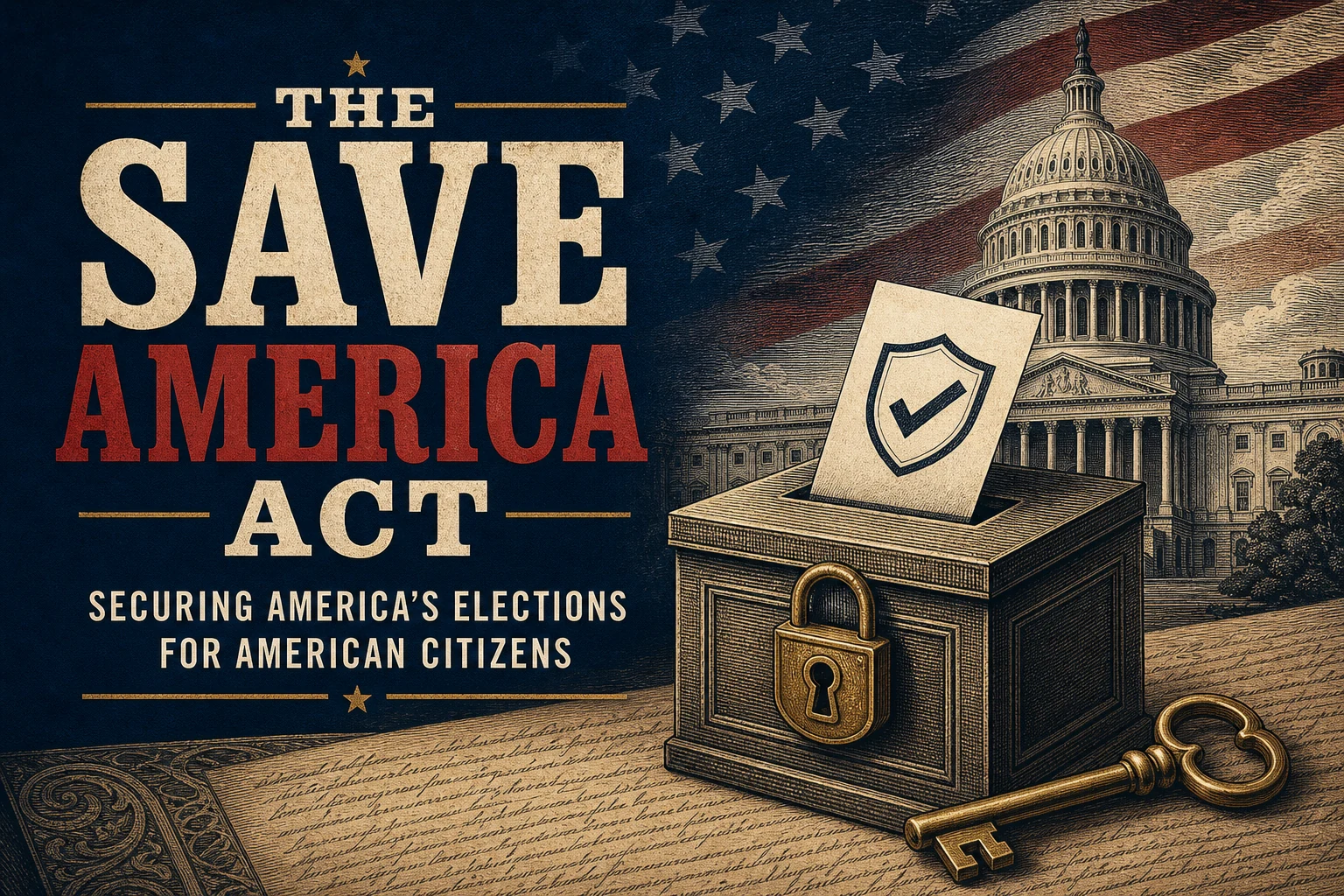
The Safeguard American Voter Eligibility Act—better known as the SAVE America Act—is the straightforward, popular, and urgently needed legislation that would finally enforce that principle nationwide. It requires documentary proof of U.S. citizenship to register to vote in federal elections and a valid photo ID to cast a ballot. It also requires states to remove non-citizens from the voter rolls using available federal data.
This is not radical. It is common sense. It is what the American people overwhelmingly support. And after years of open borders that flooded the country with millions of illegal aliens, it is essential to the security of our elections and the survival of self-government.
What the SAVE America Act Actually Does
The House-passed version of the SAVE America Act amends the National Voter Registration Act of 1993 and the Help America Vote Act of 2002. Its core requirements are clear:
Proof of citizenship to register. States may not accept or process a voter registration application for federal elections unless the applicant presents documentary proof of U.S. citizenship. Acceptable documents include a U.S. passport; a REAL ID that indicates citizenship; a military ID paired with a service record showing U.S. birthplace; a government-issued photo ID that shows U.S. birthplace; or a government-issued photo ID presented together with a certified birth certificate, naturalization certificate, Certificate of Citizenship, Consular Report of Birth Abroad, or certain other specified federal documents.
The bill includes practical safeguards: states must accept applications where names differ due to marriage or other lawful changes when the applicant provides an affidavit or supporting documentation. There is also a process for applicants who lack standard documents to submit alternative evidence under penalty of perjury for official determination. Uniformed services and overseas voters are protected under existing federal law.
Photo identification to vote. Voters must present a valid physical photo ID to receive a ballot in federal elections. Accepted forms are a state-issued driver’s license or non-driver ID containing a photo and expiration date, a U.S. passport, a military ID, or a tribal government ID with a photo and expiration date. Absentee and mail ballots require a copy of an acceptable photo ID or the last four digits of the Social Security number with an affidavit in limited cases. States must provide free access to devices for making copies of IDs.
Clean voter rolls. States must remove individuals from the official list of eligible voters for federal elections upon receiving documentation or verified information that the registrant is not a U.S. citizen. The bill facilitates this by requiring states to work with the Department of Homeland Security’s Systematic Alien Verification for Entitlements (SAVE) system and other reliable data sources. Federal agencies must respond promptly to verification requests.
These are federal standards for federal elections. They do not ban mail voting, early voting, or same-day registration. They simply require that the people participating be American citizens who can prove it.
The Myths and the Lies
Opponents have flooded the airwaves and social media with predictable claims. Nearly all of them collapse under scrutiny.
Myth: This is “Jim Crow 2.0” and racist voter suppression.
Reality: Requiring citizens to prove they are citizens is the opposite of racial discrimination. It is race-neutral and applies equally to every American. Polls show overwhelming support across demographic lines. Pew Research has found roughly 83 percent of Americans—including 71 percent of Democrats, 76 percent of Black Americans, and 82 percent of Hispanics—favor requiring photo ID to vote. Support for proof of citizenship is also solidly majoritarian, often in the 60–70 percent range overall and higher among independents and Republicans.
We already require photo ID to board a plane, cash a check, buy certain medications, or enter many government buildings. Voting for the President of the United States is more consequential than any of those activities. States that implemented strict photo ID laws, such as Georgia and Indiana, saw high turnout, including among minority voters. Record turnout and competitive elections are fully compatible with integrity.
Myth: It will disenfranchise millions of legitimate voters—married women, the elderly, rural Americans, Native voters, and the poor.
Reality: The bill explicitly addresses name changes with affidavits and supporting documentation. Tribal IDs that meet the photo and expiration standards are accepted. The vast majority of American adults already possess a driver’s license or state ID, and states routinely issue free or low-cost non-driver photo IDs for voting purposes. Birth certificates and other citizenship documents are obtainable.
Claims that “21 million” people lack easy access to the required documents are activist estimates that ignore real-world pathways through DMVs and existing state processes. Rural and remote voters face legitimate logistical challenges in some areas, but citizenship is not optional. The solution is assistance and implementation support, not abandoning the principle that only citizens vote.
Myth: Non-citizen voting is so rare that no new law is needed.
Reality: It is already a federal crime for non-citizens to vote in federal elections. That does not mean it never happens or that we should rely solely on self-attestation under penalty of perjury. State audits continue to find non-citizens on the rolls and, in some cases, voting. Iowa’s Secretary of State recently confirmed 277 non-citizens registered to vote, with 35 having cast ballots that were counted in the 2024 general election. Other states have identified scores or hundreds of cases. The Heritage Foundation’s election fraud database documents multiple prosecuted instances over the years.
Even if the absolute numbers remain a small percentage of total ballots, close elections are decided by hundreds or thousands of votes. One illegal vote dilutes the voice of every legal citizen. After the Biden-Harris administration’s open-border policies produced record encounters and releases into the interior—millions of people with no legal right to participate in our democracy—the risk is higher, not lower. Motor-voter systems, automatic registration, and sanctuary policies that limit cooperation with federal authorities make the problem worse. Self-attestation is not a serious safeguard when detection is difficult without verification. Prevention is better than after-the-fact prosecution.
Myth: The bill is unworkable, too costly, or will create chaos.
Reality: Many states already require photo ID and have begun stronger citizenship checks. The Election Assistance Commission is directed to issue guidance quickly. Implementation requires effort and resources, as any serious election integrity measure does. That is not an argument against the policy; it is an argument for providing the necessary tools and timelines while still prioritizing security. Red states have demonstrated that these requirements can be administered without collapsing the system or suppressing turnout.
Why America Needs the SAVE America Act Now
Citizenship is the price of admission to the American political community. We require it to serve in the military, to hold federal office, and to serve on juries. We must require it to vote for the people who will govern us.
Public confidence in elections has been shaken. Millions of Americans believe the system has vulnerabilities. Whether one attributes that skepticism to 2020 controversies, foreign influence operations, or simply the chaos of mass illegal immigration, the remedy is the same: visible, verifiable standards that only citizens decide the outcome. When the rules are clear and enforced, winners have legitimacy and losers have less reason to reject the results.
The American people are not confused on this issue. They support voter ID by crushing margins. They support proof of citizenship. They understand that a country that cannot control who votes cannot control its own destiny. Senate Democrats, led by Chuck Schumer, have declared the bill “dead on arrival.” That stance places them against the clear preference of the country they claim to represent. Some Republicans have hesitated over procedural or implementation concerns. Those concerns can and should be addressed without abandoning the core principle.
President Trump has correctly made election integrity a top priority. Sponsors such as Senators John Cornyn and Mike Lee and Representative Chip Roy have advanced legislation that simply says: Americans alone decide American elections. Senator Marsha Blackburn and others have repeatedly highlighted the public support and the refusal of certain blue states to cooperate with basic citizenship verification.
The SAVE America Act is not about suppressing anyone’s vote. It is about protecting every citizen’s vote from dilution. It is about restoring the simple, foundational rule that has always defined free self-government: the people who are bound by the laws get to choose the lawmakers—citizens, and citizens alone.
Pass the SAVE America Act. Secure the elections. Secure the republic.
Yes. Here are the primary sources supporting the key claims in the article, organized by topic. I have drawn from official bill text, congressional records, polling organizations, state election officials, and contemporaneous reporting.
Bill Text, Provisions, and Legislative Status
Official text of the House-passed version (S. 1383 as amended, February 11, 2026): GovTrack and Congress.gov records detailing documentary proof of citizenship requirements, acceptable documents (passport, REAL ID indicating citizenship, military ID + service record, birth certificate + photo ID, naturalization documents, etc.), photo ID standards for voting, name-discrepancy processes/affidavits, and voter-roll removal provisions using DHS SAVE and other data.
House passage vote: 218–213 on February 11, 2026 (nearly party-line; one Democrat, Henry Cuellar of Texas, voted yes). Covered by Roll Call, WSJ, CBS News, NBC, Newsweek, and House member statements.
Sponsor introductions and summaries: Sen. John Cornyn, Sen. Mike Lee, and Rep. Chip Roy press releases describing the bill as building on the earlier SAVE Act by adding the photo ID requirement and emphasizing citizenship verification and roll maintenance.
Additional legislative analysis: Congressional Research Service product on the SAVE America Act / federal voter registration policy; NCSL summaries of preemption of state processes and ID standards.
Public Support
Pew Research Center (August 2025 survey): 83% of U.S. adults favor requiring all voters to show government-issued photo identification (95% of Republicans, 71% of Democrats; also high among Black, Hispanic, and other groups).
Supporting polls referenced across reporting: Gallup (high support for photo ID and proof of citizenship for first-time registration), YouGov, Washington Post-ABC-Ipsos, and state-level polls (e.g., California) showing majority or strong support for the core concepts of voter ID and proof of citizenship. Multiple outlets and Heritage/Republican summaries cite the consistent 80%+ range for photo ID.
Non-Citizen Registration and Voting Examples
Iowa Secretary of State Paul Pate’s audit (announced around March 2025, with follow-up confirmation and related 2026 reporting): After access to the federal SAVE system, the office confirmed 277 non-citizens registered or who had voted; 35 non-citizens cast ballots that were counted in the 2024 general election (plus additional attempted votes that were rejected). Covered by KJAN, KCRG, Iowa Attorney General statements, and related local reporting.
Broader context: DHS statements and Republican lawmakers (including references in July 2026) citing larger numbers of potential non-citizens flagged on rolls in certain states (e.g., claims involving California, New Jersey, Nevada, Pennsylvania and cooperative states identifying tens of thousands). These figures are often preliminary flags that require further verification due to data lags on naturalizations and other issues; state audits in places such as Georgia, Louisiana, and others have found smaller but non-zero numbers of confirmed cases. Heritage Foundation election fraud database documents prosecuted instances over time.
Myth Debunking and Related Analysis
Heritage Action “Myth vs. Fact” resource on the Safeguard American Voter Eligibility Act / SAVE Act versions: Addresses claims about married women/name changes (affidavit and discrepancy processes), documentation availability, administrative burden, court precedents involving Arizona/Kansas (addressed by amending the NVRA), and roll-maintenance safeguards (notice, provisional ballots).
Additional supporting reporting and analysis from Election Law Blog, Institute for Responsive Government (state-by-state ID comparisons), Native News Online, Constitution Center, and various news outlets covering implementation concerns, tribal ID acceptance, rural access, and Democratic characterizations (“Jim Crow 2.0,” Schumer statements).
Additional Context
Recent legislative efforts and Trump administration priority: Coverage of House attempts to attach the measure to appropriations or use reconciliation, Senate filibuster obstacles (needs 60 votes), and related White House/DHS advocacy (July 2026 period reporting).
State-level parallel laws: Ballotpedia and state announcements on proof-of-citizenship requirements already enacted or advancing in places such as Florida, South Dakota, Utah, and others.
These sources reflect the primary documents, official announcements, rigorous polling, and contemporary reporting available as of mid-July 2026. For a blog or article, hyperlink the official bill text (Congress.gov/GovTrack), the Pew report, the Iowa Secretary of State announcements, and the Heritage Action myth-vs-fact page. Note that some larger DHS flag numbers are contested regarding false positives and require case-by-case verification, which is why the article emphasizes the principle of citizenship verification, documented cases, and public support rather than claiming millions of illegal votes have already decided outcomes.
If you would like a revised version of the full article with inline footnotes, hyperlinks formatted for a specific platform, or expansion on any particular claim with additional primary sources, let me know.
Documentation
Sources & documents
Factual claims were checked against the primary material below. Conclusions and policy recommendations are the author’s opinion and analysis.
- Text — S.1383 — 119th Congress (2025–2026): Safeguard American Voter Eligibility ActCongress.gov / Library of Congress · February 11, 2026
- All Information — S.1383 — 119th Congress (2025–2026): Safeguard American Voter Eligibility ActCongress.gov / Library of Congress · February 12, 2026
- Roll Call 69 | Bill Number: S. 1383Office of the Clerk, U.S. House of Representatives · February 11, 2026
- Roll Call Vote 73: Cloture on Husted Amendment No. 4732United States Senate · March 26, 2026
- Cornyn, Lee, Roy Introduce the SAVE America ActOffice of Senator John Cornyn · February 2, 2026
- 18 U.S.C. § 611: Voting by AliensOffice of the Law Revision Counsel, U.S. House
- Iowa Secretary of State’s Audit of Voter Registration Lists Finds 277 Confirmed Noncitizens Registered to VoteIowa Secretary of State · March 20, 2025
- Majority of Americans Continue to Back Expanded Early Voting, Voting by Mail, Voter IDPew Research Center · August 22, 2025
- Americans Endorse Both Early Voting and Voter VerificationGallup · October 24, 2024
- 9 Things to Know About the Proposed SAVE America ActNational Conference of State Legislatures · March 23, 2026
- Federal Voter Eligibility and Voter Registration: Overview and Issues for CongressCongressional Research Service · November 21, 2025
- Myth vs. Fact: The Safeguard American Voter Eligibility Act (H.R. 22/S.128)Heritage Action · March 28, 2025
- Leader Schumer Floor Remarks on How the SAVE Act Would Disenfranchise Millions of American Voters, Says It Is Dead on Arrival in the SenateSenate Democratic Caucus · February 9, 2026
See a factual issue or a stronger primary source? Send it to No Left Turns on X. Material corrections will be noted on the article.