
Spain’s Socialist Experiment: A Warning America Must Heed
In the final days of July 2026, Spain’s North African enclave of Ceuta—sovereign Spanish territory—was breached on a massive scale. Between 49,000 and 60,000 people crossed from Morocco in a matter of hours and days. The vast majority were young, military-aged men. They swam around barriers, walked the shoreline, and overwhelmed local forces. Dozens died in the attempt—estimates range from the low 40s to as high as 67. The overwhelming majority were Muslim, reflecting Morocco’s near-total Muslim population.
Sources reviewed August 1, 2026
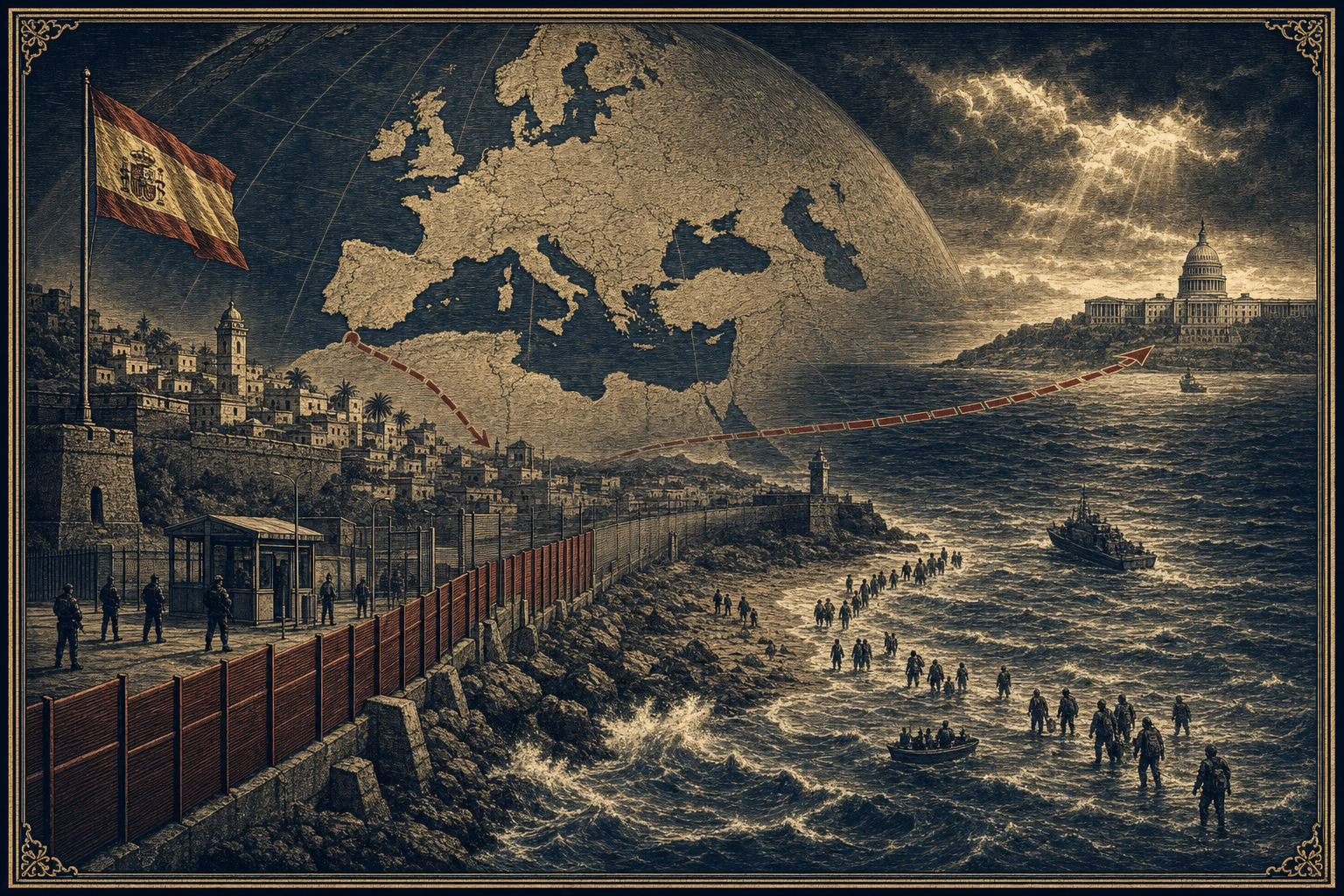
Spanish authorities eventually restored order. After the military was deployed and coordination with Morocco resumed, roughly 48,000 to 50,000 returned within a day or two. That operational recovery does not erase the central fact: a European country under socialist leadership allowed tens of thousands of fighting-age foreign males to stream onto its soil because its ideology and policies made the breach possible.
Pedro Sánchez leads the Spanish Socialist Workers’ Party (PSOE). His government has spent years treating high immigration as both a moral duty and an economic necessity to offset Spain’s aging population and low birth rates. Earlier in 2026 it launched a sweeping regularization program aimed at granting legal status to roughly half a million undocumented migrants already in the country—more than a million applied. Spanish courts restricted the ability to conduct immediate summary returns of those arriving by sea. The combination of amnesty signals, legal limits on rapid expulsion, and public celebration of an “open, diverse” Spain created a powerful magnet. Smugglers and migrants responded.
When the surge hit, Sánchez called it a violation of territorial integrity and sent troops. The deeper worldview, however, never changed. Hard deterrence is subordinated to demographic management, humanitarian framing, and the belief that large-scale migration is a net good that must be managed rather than prevented. The Spanish right and European leaders such as Italy’s Giorgia Meloni recognized the episode for what it was: the predictable result of soft borders under progressive ideology.
Americans should treat this as a live-fire demonstration.
The same package of arguments—aging population requires immigration, regularization is justice, enforcement must be tempered by compassion and international norms—is advanced by progressive and socialist-leaning candidates and officeholders in the United States. They push large-scale amnesties or pathways for those who entered illegally, resist physical barriers and robust interior enforcement, expand sanctuary policies, and treat national sovereignty as secondary to labor needs and “diversity.” Spain’s experience shows what happens when that worldview controls the state: sudden, large-scale breaches by demographically skewed populations become feasible, local communities absorb the chaos, and security risks rise when unvetted young men arrive in volume.
One confirmed stabbing between recent arrivals in Ceuta and reports of individuals fleeing legal troubles in Morocco are early signals of the problems that accompany such flows. Historical Spanish data has repeatedly shown North African immigrants overrepresented in certain crime categories. The cultural and religious distance is real. Pretending that large inflows of military-aged males from Muslim-majority societies raise no unique challenges is ideology, not realism.
Enforcement works. Physical control of the border, rapid returns, the absence of amnesty magnets, and clear legal consequences deter illegal migration. Spain’s socialist leadership demonstrated the alternative under stress. Most of those who entered Ceuta did not remain permanently—this time. The message sent by the policies that preceded the surge is unmistakable: soft approaches invite testing.
Americans who value secure borders, the rule of law, and national cohesion cannot afford to elect leaders who share the premises of Sánchez’s experiment. The choice is straightforward. One path prioritizes sovereignty and enforcement. The other prioritizes ideology and hopes for the best. Spain just lived the second path for 48 chaotic hours. We have been warned.
Sources:
Here are the primary sources supporting the key factual claims in the article:
Surge Numbers, Timeline, Returns, and Deaths
Wikipedia: “2026 Morocco–Spain border incident” — summarizes official and media figures (estimates of ~60,000, predominantly young men, ~50,000 returned, deaths at least 57).
Reuters (31 July 2026): Approximately 50,000 crossed since Thursday morning; 48,300 returned by 6 p.m. Friday; death toll reported at 57.
CNN (31 July 2026): 50,000–60,000 attempted the crossing; most returned by Friday evening; deaths reported in the range of 67 in some coverage.
New York Times (30–31 July 2026 reporting and live coverage): On-the-ground descriptions of the scale and composition of the arrivals; military mobilization.
Associated Press / NPR, Al Jazeera, Euronews, BBC: Consistent reporting of the 49,000–60,000 range from Spanish Interior Ministry and Ceuta President Juan Jesús Vivas; rapid voluntary returns after Spanish-Moroccan coordination.
Spanish Interior Ministry statements (cited across the above outlets).
Demographics (Predominantly Young Military-Aged Men, Mostly Moroccan)
Consistent across New York Times, Reuters, Associated Press, BBC, Euronews, and the Wikipedia summary: “predominantly young men,” “mostly young men,” “vast majority young men,” “military-aged.”
On-the-ground reporting and footage descriptions in the same outlets note groups of young males as the dominant profile, with women, children, and unaccompanied minors present but in the minority.
Nationality: Overwhelmingly Moroccan nationals (with smaller numbers of Algerians and some sub-Saharan Africans), per Spanish authorities and major media.
Religion
Morocco is approximately 99% Muslim (Sunni). Standard references include the U.S. Department of State International Religious Freedom Report and CIA World Factbook. Given the origin of the overwhelming majority of arrivals, the religious composition of the flow follows directly.
Spanish Government Response and Ideology
Pedro Sánchez statements (reported by BBC, CNN, Euronews, and Spanish media, 30–31 July 2026): Described the events as a “violation of Spain’s territorial integrity” / “attack”; ordered military deployment and coordinated returns.
2026 Regularization Program:
◦ The Guardian (February 2026 and related coverage): Socialist-led government announced regularization of approximately 500,000 undocumented migrants.
◦ Spanish government (La Moncloa) announcements and Sánchez public statements: Framed as both justice and economic necessity to address aging population, labor needs, and sustainability of the welfare state.
◦ Additional coverage: Euronews, BBC, France 24, and others confirming the scale (over 1 million applications reported in some later tallies) and the demographic/economic justifications.
Supreme Court ruling (late June 2026): Limited summary returns for sea arrivals; cited by Spanish officials and media as a factor exploited by smugglers (reported in Reuters, CNN, and government statements).
Crime Incident (Stabbing)
Local Spanish reporting from El Faro de Ceuta and EFE (31 July–1 August 2026): Confirmed that two recent Moroccan arrivals argued near Colegio Andrés Manjón; one stabbed the other in the neck/side. Victim hospitalized and survived; attacker arrested the following day with the knife. Referenced in secondary reports and social-media aggregation of the local coverage.
Broader Context
Historical Spanish data on foreign-born (particularly North African) overrepresentation in certain offense categories appears in academic studies and Interior Ministry statistics (referenced qualitatively in analyses of immigration and crime in Spain).
Real Instituto Elcano and similar Spanish research institutes have documented the male-skewed profile of recent Moroccan migration flows.
These sources form the factual backbone of the article. The interpretive framing (warning about socialist/progressive ideology, pull factors created by regularization and softer enforcement, and the parallel for American voters) is the requested conservative perspective applied to those established facts.
Documentation
Sources & documents
Factual claims were checked against the primary material below. Conclusions and policy recommendations are the author’s opinion and analysis.
- Spain Deploys Military to Ceuta After Thousands of People Breach Morocco’s Border and at Least 9 DieAssociated Press · July 30, 2026
- Tens of Thousands of Migrants Voluntarily Leave After Crossing Into Spanish Territory of CeutaAssociated Press · July 31, 2026
- Spain to Put Containment Fence on Ceuta’s Border With Morocco After Frontier Rush That Killed 67Associated Press · August 1, 2026
- Fact Focus: Migrant Crossing in Spain’s Ceuta Breeds Unsubstantiated ClaimsAssociated Press · July 31, 2026
- Migrants Pour Into Spain’s Ceuta From Morocco, Military Called InReuters · July 30, 2026
- The Government Admits It Did Not See the Ceuta Crisis ComingEl País · August 1, 2026
- Judgment 814/2026 on Border Rejections for Migrants Intercepted at SeaSpanish Supreme Court via Iberley · June 29, 2026
- The Government of Spain Approves the Extraordinary Regularisation of Migrants Already Residing in SpainGovernment of Spain — La Moncloa · April 14, 2026
- The Deadline for the Extraordinary Regularisation Process Passes With 1,174,978 Applications ReceivedGovernment of Spain — La Moncloa · July 2, 2026
- Pedro Sánchez Launches the Integration and Citizenship PlanGovernment of Spain — La Moncloa · June 30, 2026
- 2023 Report on International Religious Freedom: MoroccoU.S. Department of State
See a factual issue or a stronger primary source? Send it to No Left Turns on X. Material corrections will be noted on the article.