
The Price Level Was Set Under Biden. The Midterms Will Turn on Whether Republicans Say So.
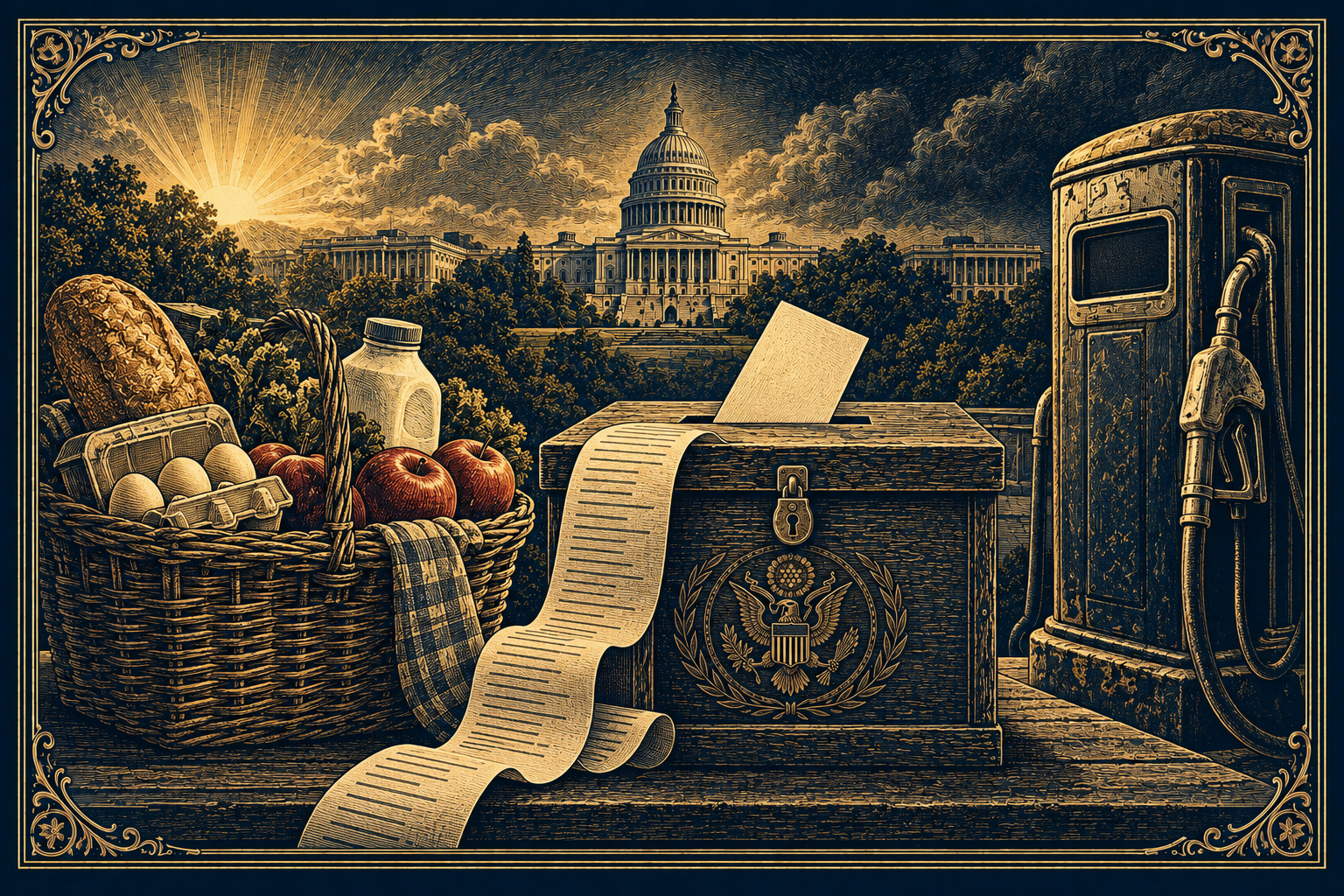
Democrats have already chosen their midterm theme. Affordability. Gas. Groceries. The cost of a normal life. The argument they will run from now until November is simple: prices are high, Trump is president, therefore Trump owns the prices.
It is a clean story. It is also incomplete in a way that matters. Republicans have so far been strangely quiet about the part that is incomplete.
The economy in the fall of 2026 is not in crisis. It is a solid expansion sitting on top of a permanently higher price level that was built between 2021 and 2023. Those are two different facts. Democrats are campaigning on the second and hoping voters forget who created it. Republicans should stop letting them.
The numbers that actually describe this economy
Start with the labor market, because it is the cleanest positive.
The unemployment rate stood at 4.1 percent in August 2026, according to the Bureau of Labor Statistics. That is full employment by any historical standard. The long-run average since the late 1940s is closer to 5.7 percent. Payroll employment rose by 162,000 in August. Job losses remain near historic lows. This is not the labor market voters remember from the inflation-spike years.
Growth is ordinary and real, not spectacular and not collapsing. The Bureau of Economic Analysis put real GDP at a 2.5 percent annual rate in the first quarter of 2026 and 2.2 percent in the second, according to the third estimate released September 30. Consumer spending and investment are carrying it.
Markets have noticed. The S&P 500 closed October 1 at 7,666.45, up about 12 percent for the year, with the Dow Jones Industrial Average near 50,927 and the Nasdaq up about 15.6 percent year to date, according to the Associated Press market wrap that day. Equity wealth is not the same thing as a grocery bill. It is evidence that capital is not treating the United States as a failing enterprise.
Wages have more than kept pace with the most recent inflation outside the energy spike. From January 2025 through August 2026, nominal average hourly earnings rose about 5.3 percent while prices rose about 4.8 percent, leaving real wages modestly higher than at the start of the term, according to the Private Enterprise Research Center at Texas A&M. That is the opposite of the pattern in 2021 and 2022, when prices ran far ahead of paychecks.
Inflation itself is no longer the 2022 emergency. The Consumer Price Index rose 3.4 percent in the twelve months through August 2026. Core inflation, which strips out food and energy, was 2.4 percent. The headline number is being pulled up by energy. The energy index was up 16.3 percent over the year, and gasoline was up sharply, because of the Iran conflict and disruption around the Strait of Hormuz. That is a real cost to households. It is also a geopolitical shock, not a domestic demand boom.
Where the high prices actually came from
The rate of inflation and the level of prices are not the same thing. The rate has come down. The level has not gone back.
In June 2022 the CPI rose 9.1 percent from a year earlier, the highest reading since 1981. The full-year inflation rate in 2022 was 8.0 percent. From the start of the Biden term to its end, the overall price level rose on the order of 21 percent. One accounting published as Biden left office put cumulative inflation over the term at about 21.2 percent against earnings growth of about 19.4 percent. Grocery prices, shelter, and vehicles moved even more in the early years of that surge. Nominal wages rose, but not enough to offset the jump while it was happening. Real weekly earnings fell through the first half of the Biden term and only partially recovered by the end of it. Households still feel that gap every week.
The causes are not mysterious. The American Rescue Plan poured roughly $1.9 trillion of demand into an economy already reopening into supply constraints. Federal Reserve and administration officials spent much of 2021 calling the resulting inflation transitory. Energy policy constrained domestic production just as the Russia-Ukraine war removed Russian barrels from the market. Research from the Federal Reserve Bank of San Francisco and related academic work has attributed a meaningful share of the 2021–22 inflation overshoot — on the order of one to three percentage points or more, depending on the study — to the scale of that fiscal stimulus.
Gasoline peaked just over $5 a gallon nationally in June 2022. By the time Biden left office the national average was back near $3.10. The broader price level never reversed. Inflation cooling from 9 percent to 3 percent does not put the grocery bill back where it was in January 2021. It means the bill stops rising as fast from a much higher base.
That is the origin of the affordability problem Democrats now want to assign entirely to the current administration.
The current spike is real. It is not the origin story.
Right now the pump is ugly, and pretending otherwise is how you lose an argument with voters who fill up every week.
AAA reported a national average of $4.48 a gallon on September 24, 2026, the highest for this time of year on record, and tied the climb explicitly to lingering volatility in the Strait of Hormuz and crude oil pushed back toward $100 a barrel. By October 1 the average had eased only slightly, to about $4.41, still far above the roughly $3.16 of a year earlier and the roughly $3.11 in the week Trump was inaugurated in January 2025. Earlier in 2026, before the Iran conflict tightened the Strait, the national average had fallen under $3.
Democrats will treat today’s number as proof of a failed Trump economy. The honest counter is narrower and stronger than silence. The 2022 peak under Biden still stands higher, near $5.02. The current price is a war premium sitting on top of a price level that was already reset. It belongs in the same category as the Ukraine shock of 2022: an external hit to energy, not evidence that domestic policy reversed a boom.
The message Republicans should be running
Voters do not experience year-over-year percentages. They experience the pump and the receipt. A strong labor market and a rising market do not advertise themselves when the number on the gas station sign is $4.50.
The argument is available, and it is specific.
Prices jumped under the last administration’s spending and energy choices and never came back down. Unemployment is 4.1 percent. Output is growing at a little over 2 percent. Markets are up on the year. Paychecks have outrun non-energy inflation over the past year and a half. The gasoline spike is a war premium, the same category of external shock that produced the 2022 peak. The durable fix on energy is more supply — permitting, production, and export capacity — not price controls or another round of demand stimulus.
Republicans have not been saying this clearly enough. Reporting this week describes a party heading into the final stretch uneasy that voters still rank cost of living first, and unconvinced that tax changes on tips, overtime, and some Social Security benefits have broken through. Trump himself has said the administration is doing a poor job of promotion and a good job of running the country. That assessment is correct on the promotion half.
The midterm case requires treating the 2021–22 price-level reset as the central fact, treating the current energy spike as a separate and temporary shock, and putting the employment and growth numbers in front of voters every week until November. Democrats are going to talk about affordability whether Republicans join the argument or not. The only open question is whether the origin of the high price level gets mentioned.
Sources
U.S. Bureau of Labor Statistics, Employment Situation, August 2026 (unemployment rate 4.1 percent; payroll employment +162,000). Released September 4, 2026. United States Economy at a Glance and Unemployment Rate
U.S. Bureau of Labor Statistics, Consumer Price Index Summary, August 2026. All items +3.4 percent over the year; all items less food and energy +2.4 percent; energy index +16.3 percent. Released September 11, 2026. Consumer Price Index Summary - 2026 M08 Results
U.S. Bureau of Labor Statistics, Consumer Price Index historical 12-month changes. June 2022 all-items peak of 9.1 percent; calendar-year 2022 inflation of 8.0 percent. CPI Home : U.S. Bureau of Labor Statistics
Rick Newman, “The final accounting on ‘Bidenflation,’” Yahoo Finance, January 2025. Cumulative inflation over the Biden term of about 21.2 percent versus earnings growth of about 19.4 percent, based on BLS data. The final accounting on 'Bidenflation'
Private Enterprise Research Center, Texas A&M University, “Inflation, Real Wages, and Unemployment: The Data Through August 2026,” September 25, 2026. Nominal average hourly earnings up 5.3 percent from January 2025 to August 2026; prices up 4.8 percent; real wages about 0.5 percent higher than in January 2025. perc.tamu.edu/blog/2026/09/inflation-aug-2026.html
U.S. Bureau of Economic Analysis, Gross Domestic Product, second quarter 2026 (third estimate). Real GDP +2.2 percent in Q2 2026 and +2.5 percent in Q1 2026. Released September 30, 2026. Gross Domestic Product | U.S. Bureau of Economic Analysis (BEA)
Associated Press, “How major US stock indexes fared Thursday 10/1/2026.” S&P 500 at 7,666.45, up 12 percent year to date; Dow at 50,926.56; Nasdaq at 26,871.60, up 15.6 percent. How major US stock indexes fared Thursday 10/1/2026
AAA Newsroom, “National Average Climbs Nearly 5 Cents Since Last Week,” September 24, 2026. National average $4.48 a gallon, highest for this time of year, attributed to Strait of Hormuz volatility and crude prices. National Average Climbs Nearly 5 Cents Since Last Week – AAA Newsroom
AAA fuel data and U.S. Energy Information Administration weekly retail gasoline series. National average near $4.41 on October 1, 2026, versus about $3.16 a year earlier; about $3.11 in the week of January 20, 2025; June 2022 peak just over $5 a gallon. AAA Fuel Prices and Gasoline and Diesel Fuel Update
Dean Baker, “The Price of Gas: Trump and Biden,” Center for Economic and Policy Research, August 14, 2026. The Price of Gas: Trump and Biden
Federal Reserve Bank of San Francisco and related research on the contribution of pandemic-era fiscal stimulus to the 2021–22 inflation overshoot, including work attributing roughly a few percentage points of the surge to stimulus. Federal Reserve Bank of San Francisco
Burgess Everett, “‘The No. 1 thing’: Republicans agonize over their economic inaction,” Semafor, October 1, 2026. ‘The No. 1 thing’: Republicans agonize over their economic inaction
Reuters, “Republicans’ awkward midterms dance with Trump,” October 1, 2026. Includes Trump’s remark that the administration is doing “an extremely poor job of promotion and an extremely great job of running the country.” NEWSLETTER: Republicans’ awkward midterms dance with Trump