
Democrats’ Affordability Message Is a Slogan, Not a Plan
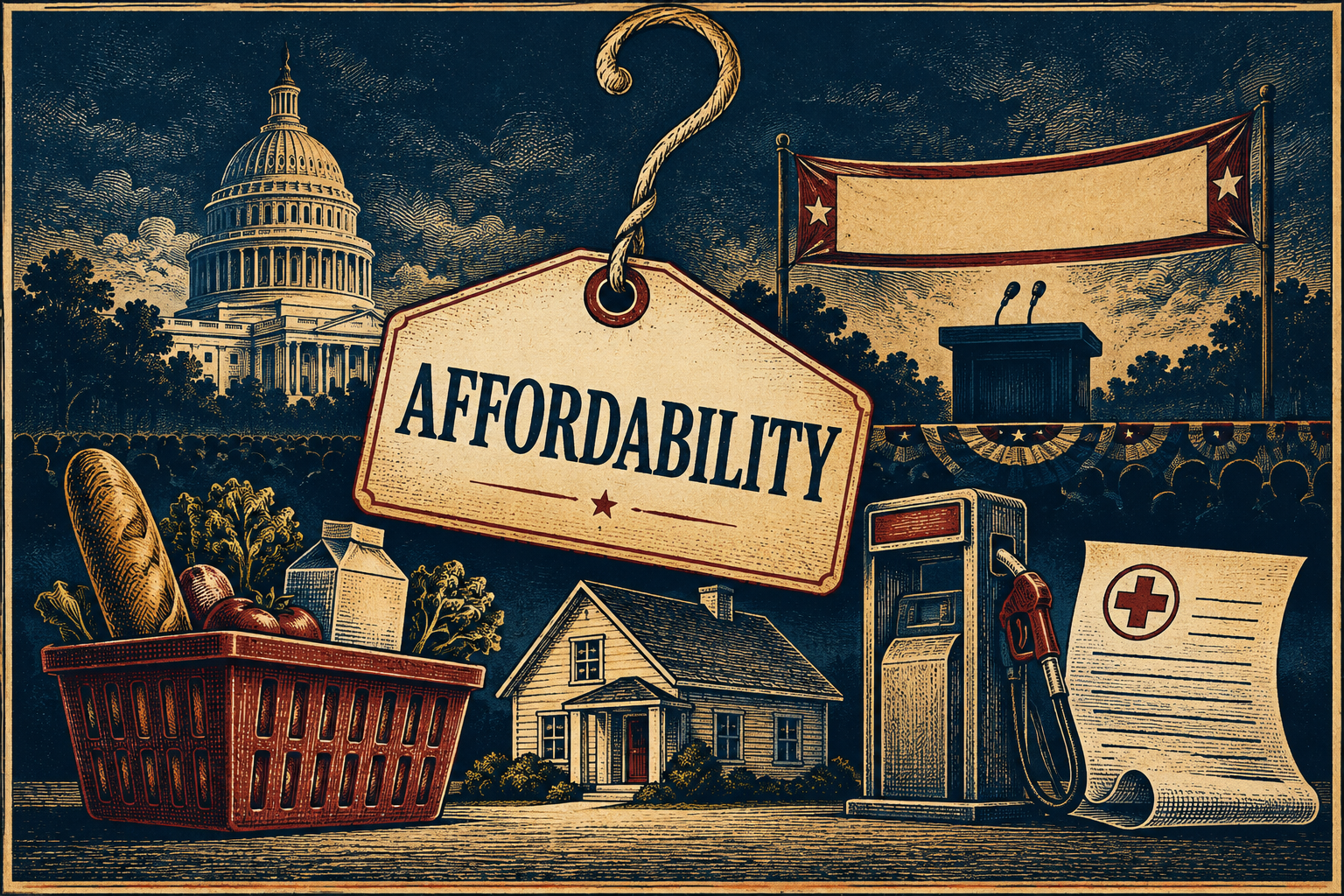
Democrats’ 2026 midterm message on prices is mostly a slogan and a blame assignment, not a communicated plan to lower them. House Minority Leader Hakeem Jeffries and Democratic candidates have made “affordability” or “Fighting for an Affordable America” the central refrain. Campaign events feature oversized banners with the word “AFFORDABLE,” tours carry names such as “Make Stuff Cost Less,” and the repeated claim is that costs for groceries, gas, housing, and healthcare are too high because of Trump’s tariffs, the Iran war, and Republican legislation. When asked what Democrats would actually do, the answers remain high-level: end the tariffs, end the war, reverse Medicaid changes, restore Affordable Care Act tax credits, and “decisively act” through working groups on housing, healthcare, energy, groceries, and caregiving. Detailed mechanisms that expand supply or reduce production costs are rarely the centerpiece of the public message.
This is consistent across high-profile statements. Jeffries has described the unifying theme as “fighting for an affordable America” and promised to “drive down the cost of groceries, gas and housing” and make healthcare affordable, while listing the same short set of reversals (tariffs, war, Medicaid cuts, ACA credits). Progressive Caucus documents contain more specific proposals—government generic drug manufacturing, childcare cost caps or subsidies, utility rate standards, higher overtime pay, and down-payment assistance funded by new taxes—but these receive less campaign airtime than the slogan and the Trump critique. The version voters most often encounter is the mantra plus the external blame.
The Policies That Do Get Specified Tend to Raise Underlying Costs
When concrete ideas surface, they largely rely on tools that raise production costs, constrain supply, or shift burdens without lowering the resource cost of goods and services. Taxes and regulations are partly passed through to consumers via higher prices or reduced output. Wage mandates do the same in competitive markets. Subsidies can lower the net price some households pay while increasing demand and the overall bill.
Empirical patterns match the economics:
Housing construction costs in heavily regulated jurisdictions run substantially higher. A 2025 RAND analysis of completed multifamily projects found costs in California roughly 2.3 times those in Texas (and higher still in the Bay Area). Key drivers include permitting timelines more than 22 months longer on average, municipal impact and development fees averaging about $29,000 per unit versus under $1,000 in Texas, prevailing-wage requirements, and layered environmental and design rules. These are policy choices that directly increase the cost of new supply.
Energy rates are higher in states with aggressive renewable portfolio standards and related mandates that prioritize intermittent sources while constraining conventional production. The gap relative to lower-regulation states is large and persistent.
Healthcare regulations and coverage mandates under the ACA were associated with large premium increases in the individual market in the years after implementation. Expanding subsidies or tax credits addresses the net price for some households but does not reverse the underlying cost structure.
Minimum-wage and other labor mandates show documented price pass-through, particularly in restaurants, retail, and other low-margin sectors.
Price controls and rent freezes reduce new supply and maintenance over time, as shown in multiple city-level studies. Government-run or heavily subsidized options require ongoing taxpayer funding and rarely sustain lower costs once administrative overhead and effects on private competition are included.
The large 2021–2022 inflation surge—peaking at 9.1 percent year-over-year in June 2022, with a cumulative CPI rise of roughly 21 percent from early 2021 to early 2025—occurred under Democratic control of the White House and both chambers for much of the period, amid large fiscal stimulus including the $1.9 trillion American Rescue Plan. Multiple analyses attribute a meaningful share of that demand-driven increase to the stimulus when supply was constrained. Today’s elevated price level is the cumulative result. Restoring prior subsidies or adding new ones does not unwind it.
Why the Communication Stays at the Slogan Level
The slogan is politically useful because the complaint about high prices is widely shared and requires no defense of past results. Blaming tariffs, the war, or specific legislation is straightforward. Explaining that higher taxes, more mandates, slower permitting, or expanded demand-side spending raise costs or fail to expand supply is harder and conflicts with the party’s usual toolkit. Some Democrats have gestured toward “abundance” ideas of cutting housing red tape and increasing supply, but these remain secondary in the dominant campaign communication. The result is a message voters hear repeatedly—“affordability,” Trump’s fault—without a clear, communicated pathway that would actually reduce the cost of producing and delivering goods and services.
Voters experience the absolute price level and the direction of real purchasing power. A campaign that centers a slogan and an external blame assignment, while advancing policies whose predictable effects are higher production costs or constrained supply, does not constitute a plan to make things more affordable. It restates the problem in language that polls well and avoids the harder economic trade-offs.
Sources
House Democratic Leader Hakeem Jeffries press releases and statements on “Fighting for an Affordable America,” including September 16, 2026 (Capitol steps), September 29, 2026 (PBS), October 8, 2026 (Brooklyn), and related events. Democratic Leader and Congressman Hakeem Jeffries – Proudly Representing the 8th District of New York archives.
New York Times reporting on Democratic midterm messaging and candidate tours (“How Candidates Have Addressed Affordability in the Midterm Campaigns,” September 13, 2026; “Jeffries Kicks Off Midterm Sprint With Economic Pitch,” July 27, 2026).
POLITICO and other coverage of Jeffries’ closing pitch and limited specificity when pressed on legislative details.
Congressional Progressive Caucus “New Affordability Agenda” announcements and related reporting (April 2026), including government drug production, childcare proposals, utility standards, and tax-funded measures.
Bureau of Labor Statistics CPI-U data: January 2021 year-over-year rate of 1.4 percent; June 2022 peak of 9.1 percent; cumulative index rise of approximately 21 percent from January 2021 to January 2025.
RAND Corporation, “The High Cost of Producing Multifamily Housing in California: Evidence and Policy Recommendations” (2025), documenting 2.3× higher costs versus Texas, longer timelines, and higher fees driven by state and local policy.
Mercatus Center working paper (Chambers and Collins) on federal regulations and consumer prices, finding a 10 percent increase in regulations associated with roughly a 0.7 percent rise in prices, with regressive effects.
Analyses of American Rescue Plan contribution to 2021–2022 inflation (San Francisco Fed and other studies estimating multi-percentage-point effects via demand stimulus amid constrained supply).
Fox News, Wall Street Journal, and Atlantic commentary on the “affordability” pitch as tax-and-spend or interventionist measures in new packaging, and on the limited specificity of the public message.
State-level energy rate and housing shortage comparisons (various analyses of renewable portfolio standards, zoning, and permitting in blue versus red jurisdictions).