
The Truth About Socialism: What It Is, Why It Fails, and Why It Matters
Socialism is the public or collective ownership and control of the means of production—factories, land, capital, and natural resources—typically directed by the state or central planning rather than private owners and market prices. Its classical aim is production for use and more equal distribution of wealth, in explicit contrast to capitalism’s private property, voluntary exchange, and profit-and-loss signals.
Sources reviewed August 10, 2026
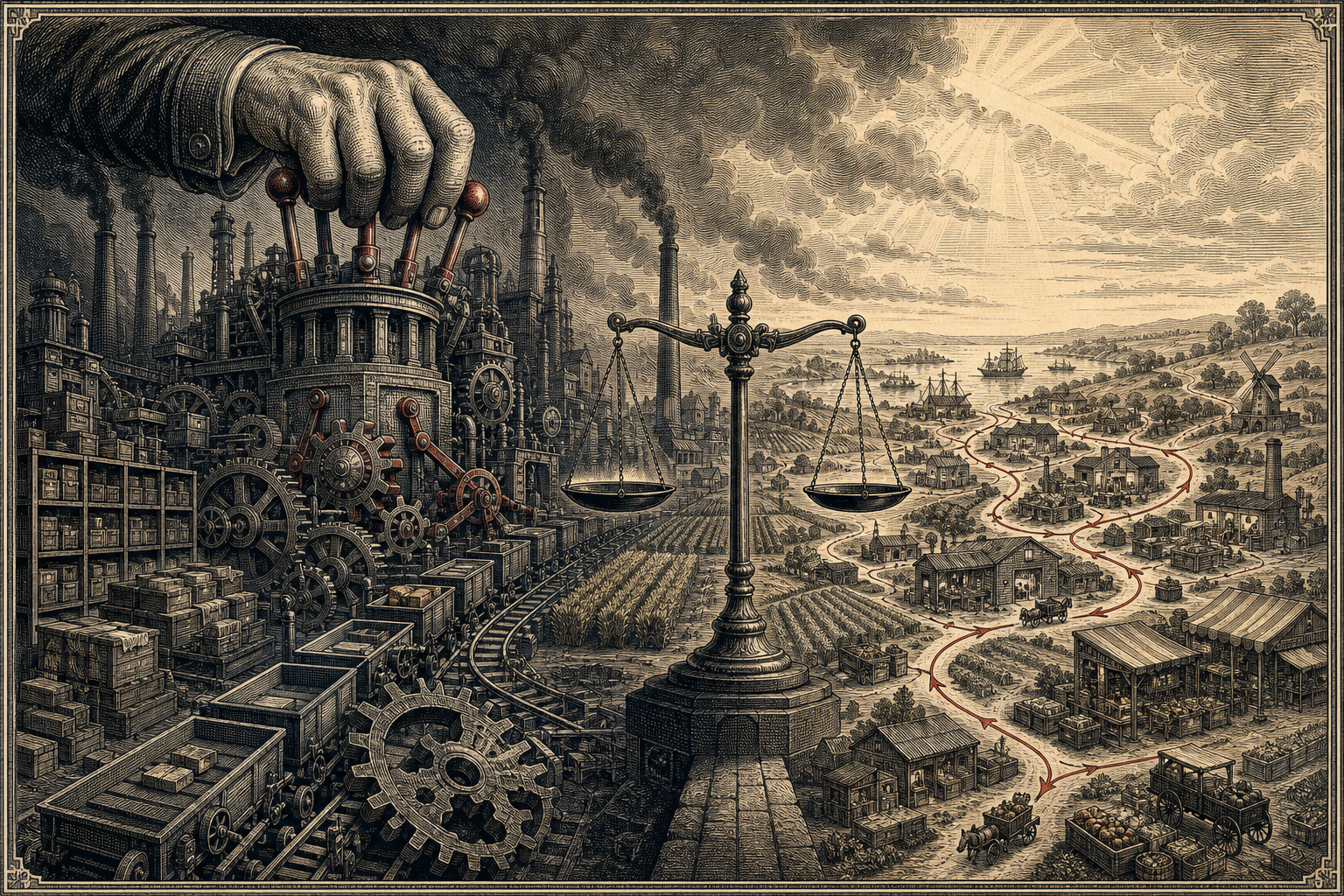
This is not a vague preference for “fairness,” higher taxes, or generous social programs. It is a structural claim about who owns and decides how resources are allocated. Karl Marx and Friedrich Engels summarized the core demand as the “abolition of private property” in the means of production. Standard reference works define it as the doctrine calling for public rather than private ownership or control of property and natural resources. Modern economic references converge on the same point: social ownership of the productive apparatus, often coordinated by planning rather than markets.
The central misconception among younger generations and much of the contemporary left
Polls repeatedly show that large shares of Americans under 30 express favorable views of “socialism”—often 50–62 percent in recent surveys. Yet when asked what the word means, far fewer describe government ownership of industry or central planning. Many instead define it as greater equality, free or heavily subsidized healthcare/education/housing, or simply “the government providing more services.”
This is not the historical or technical definition. It is closer to social democracy or an expansive welfare state financed by a still-capitalist economy. The distinction matters because the systems that actually deliver high living standards while funding large transfer programs are market economies with private ownership of the means of production.
The Nordic countries are the most common example cited by American progressives. Denmark’s former prime minister Lars Løkke Rasmussen stated plainly: “Denmark is far from a socialist planned economy. Denmark is a market economy.” The Heritage Foundation’s 2026 Index of Economic Freedom ranks Denmark 7th (score 79.0), Norway 8th (78.8), and Sweden 11th (77.8)—all “Mostly Free,” and in several cases ahead of the United States (22nd, 72.8). These countries protect private property, allow private businesses to dominate most sectors, maintain open trade, and score highly on business freedom and judicial effectiveness. Their generous welfare states are funded by the productivity of market economies that became rich before the large expansion of transfers; when they experimented more heavily with socialist-style policies in the 1970s–80s, growth stalled and they later liberalized.
Calling Scandinavia “socialist” confuses the financing of a safety net with the socialization of production itself. The same confusion appears when “democratic socialism” is presented as simply Nordic-style benefits without the historical record of attempts to socialize ownership.
The empirical record: it has not worked as a successful model
No large-scale pure socialist system has produced sustained high living standards, broad innovation, or personal freedom comparable to market-oriented peers. The pattern across dozens of experiments is consistent:
Soviet Union: Material-balance planning froze the economy into repetitive, inefficient patterns. Consumer goods lagged far behind the West. The system collapsed in 1991 after decades of shortages, black markets, and technological stagnation relative to market economies.
China under Mao: The Great Leap Forward (collectivization and backyard steel campaigns) produced the largest famine in recorded history, with scholarly estimates of excess deaths commonly in the range of 30–45 million. The Cultural Revolution added further chaos and repression. Rapid poverty reduction and growth occurred only after Deng Xiaoping’s market-oriented reforms opened space for private enterprise, special economic zones, and price signals—moving the country toward a hybrid often described as state capitalism rather than classical socialism.
Cuba: After nationalization of industry and agriculture, the country has endured chronic shortages, low productivity, and dependence on foreign subsidies (first Soviet, later Venezuelan). Living standards remain far below what would be expected given human capital and geography; mass emigration continues.
Venezuela: Once one of Latin America’s richer countries thanks to oil, the “21st-century socialism” of Hugo Chávez and Nicolás Maduro—nationalizations, price controls, expropriations, and monetary expansion—produced one of the steepest peacetime collapses on record. Living standards fell roughly 70–80 percent in the years after 2013; hyperinflation reached extreme levels; oil production itself collapsed under mismanagement; and more than 7 million people emigrated. The decline began before the tightest U.S. sanctions and was driven primarily by domestic policy.
Other cases—North Korea, Cambodia under the Khmer Rouge, Ethiopia under the Derg, various African and Eastern European experiments—followed similar trajectories of scarcity, repression, and eventual abandonment or partial market reform. Estimates of excess deaths under 20th-century communist regimes run into the tens of millions. The common defense—“that was not real socialism”—has been repeated after every major failure. The consistency of outcomes across different cultures, leaders, and decades suggests the problem is structural, not merely bad implementation.
Countries that improved after socialist periods did so by introducing private property, market prices, and profit incentives—not by doubling down on collective ownership.
Why the system fails: incentives, knowledge, and the fact that nothing is free
Ludwig von Mises identified the core theoretical flaw in 1920: without private ownership of the means of production there are no genuine markets for capital goods, and therefore no market prices that reflect relative scarcity. Planners lack the numerical signals needed to calculate whether a given use of steel, labor, or land is more valuable than the next-best alternative. The result is arbitrary allocation, chronic shortages in some goods and waste in others. F.A. Hayek added the knowledge problem: the dispersed, tacit information held by millions of individuals cannot be centralized effectively.
Incentives compound the difficulty. When individuals and firms cannot capture the residual gains (or losses) from their decisions, effort, innovation, and careful stewardship decline. Soft budget constraints—enterprises that cannot go bankrupt—encourage waste. High marginal taxes and forced redistribution reduce the returns to work, saving, and risk-taking.
“Free” healthcare, education, or groceries are not free. They are paid for by taxes (which reduce private activity), borrowing (future taxes), inflation (a hidden tax), or by simply producing less overall because incentives and calculation are impaired. Resources used for one purpose cannot be used for another; opportunity cost is inescapable. Claims that redistribution can simply transfer existing wealth without affecting the size of the pie ignore both theory and the historical record of shrinking pies under socialist systems.
Implications for the United States
The American economy’s productive capacity, technological dynamism, and high average living standards rest on private property, market prices, and the ability of individuals and firms to keep most of what they create. Expanding state ownership or comprehensive central direction of production would attack those foundations. Nordic-style welfare can be debated on its own terms (fiscal sustainability, work incentives, immigration effects), but it is not socialism and does not require abolishing private control of the means of production. Treating the two as interchangeable misleads younger voters about both the costs they would bear and the historical results of the system they are told to admire.
Socialism, properly defined, has been tried repeatedly at national scale. It has never delivered the sustained prosperity, innovation, or broad freedom its advocates promise. The countries that come closest to success today are those that retained or restored private ownership and market mechanisms. Clarity about the definition is the first requirement for an honest debate.
Sources
Definitions
Merriam-Webster Dictionary: [https://www.merriam-webster.com/dictionary/socialism](https://www.merriam-webster.com/dictionary/socialism)
Britannica: [https://www.britannica.com/topic/socialism](https://www.britannica.com/topic/socialism)
Karl Marx and Friedrich Engels, The Communist Manifesto (1848) – public domain texts available via standard editions and archives such as Marxists.org
Investopedia overview: [https://www.investopedia.com/terms/s/socialism.asp](https://www.investopedia.com/terms/s/socialism.asp)
Nordic Model Clarification
Danish Prime Minister Lars Løkke Rasmussen 2015 Harvard Kennedy School remarks (widely reported): “Denmark is far from a socialist planned economy. Denmark is a market economy.” Coverage examples include [The Local](https://www.thelocal.dk/20151101/danish-pm-in-us-denmark-is-not-socialist) and Wikiquote compilation.
Heritage Foundation 2026 Index of Economic Freedom: [https://www.heritage.org/index](https://www.heritage.org/index) and country rankings/PDF data (Denmark 7th / 79.0, Norway 8th / 78.8, Sweden 11th / 77.8, United States 22nd / 72.8; Cuba, Venezuela, and North Korea near the bottom). Full report materials available via Heritage site.
FEE analysis: [https://fee.org/articles/don-t-call-scandinavian-countries-socialist/](https://fee.org/articles/don-t-call-scandinavian-countries-socialist/)
Polls on Youth Views and Definitions
Gallup surveys on views of capitalism and socialism (including definitional questions): [https://news.gallup.com/poll/713144/americans-view-capitalism-socialism-free-enterprise.aspx](https://news.gallup.com/poll/713144/americans-view-capitalism-socialism-free-enterprise.aspx) and related Gallup polling pages.
Cato Institute / YouGov surveys on youth favorability toward socialism and communism: Cato research and commentary (e.g., [https://www.cato.org/blog/young-americans-socialism-too-much-thats-problem-libertarians-must-fix](https://www.cato.org/blog/young-americans-socialism-too-much-thats-problem-libertarians-must-fix)).
Pew Research Center surveys on views by age and party: [https://www.pewresearch.org](https://www.pewresearch.org)
Economic Theory
Ludwig von Mises, “Economic Calculation in the Socialist Commonwealth” (1920): [https://mises.org/library/economic-calculation-socialist-commonwealth](https://mises.org/library/economic-calculation-socialist-commonwealth)
Related Mises works including Socialism: An Economic and Sociological Analysis
F.A. Hayek on the knowledge problem in central planning
Historical Performance
The Black Book of Communism: Crimes, Terror, Repression (Stéphane Courtois et al., Harvard University Press): [https://www.hup.harvard.edu/books/9780674076082](https://www.hup.harvard.edu/books/9780674076082) (with standard scholarly notes on methodology and estimates)
Scholarly accounts of the Great Leap Forward (Frank Dikötter, Mao’s Great Famine; Yang Jisheng, Tombstone) documenting excess deaths in the tens of millions range
Venezuela economic analyses documenting GDP and living-standards collapse, hyperinflation, and emigration under Chávez/Maduro policies (IMF/World Bank-related data and independent studies)
Kristian Niemietz, Socialism: The Failed Idea That Never Dies (Institute of Economic Affairs)
Analyses of Cuba’s economic performance relative to counterfactuals and peers
These sources provide the primary definitions, empirical rankings, polling data, theoretical foundations, and historical case evidence underlying the article.
Documentation
Sources & documents
Factual claims were checked against the primary material below. Conclusions and policy recommendations are the author’s opinion and analysis.
- SocialismMerriam-Webster Dictionary
- SocialismEncyclopaedia Britannica
- Socialism: History, Theory, and AnalysisInvestopedia
- Danish PM in US: Denmark Is Not SocialistThe Local · November 1, 2015
- 2026 Index of Economic FreedomThe Heritage Foundation
- Don’t Call Scandinavian Countries ‘Socialist’Foundation for Economic Education
- Americans’ Views of Capitalism, Socialism and Free EnterpriseGallup
- Young Americans Like Socialism Too MuchCato Institute
- Public Opinion ResearchPew Research Center
- Economic Calculation in the Socialist CommonwealthMises Institute · 1920
- The Black Book of Communism: Crimes, Terror, RepressionHarvard University Press
See a factual issue or a stronger primary source? Send it to No Left Turns on X. Material corrections will be noted on the article.