
Trump Is Right to Demand Answers About China and the 2020 Election
The new files strengthen Trump’s case that Beijing posed a deeper election threat—and that federal officials treated inconvenient intelligence too casually. They demand accountability. The public record reviewed here does not resolve whether vote totals were affected.
Sources reviewed July 17, 2026
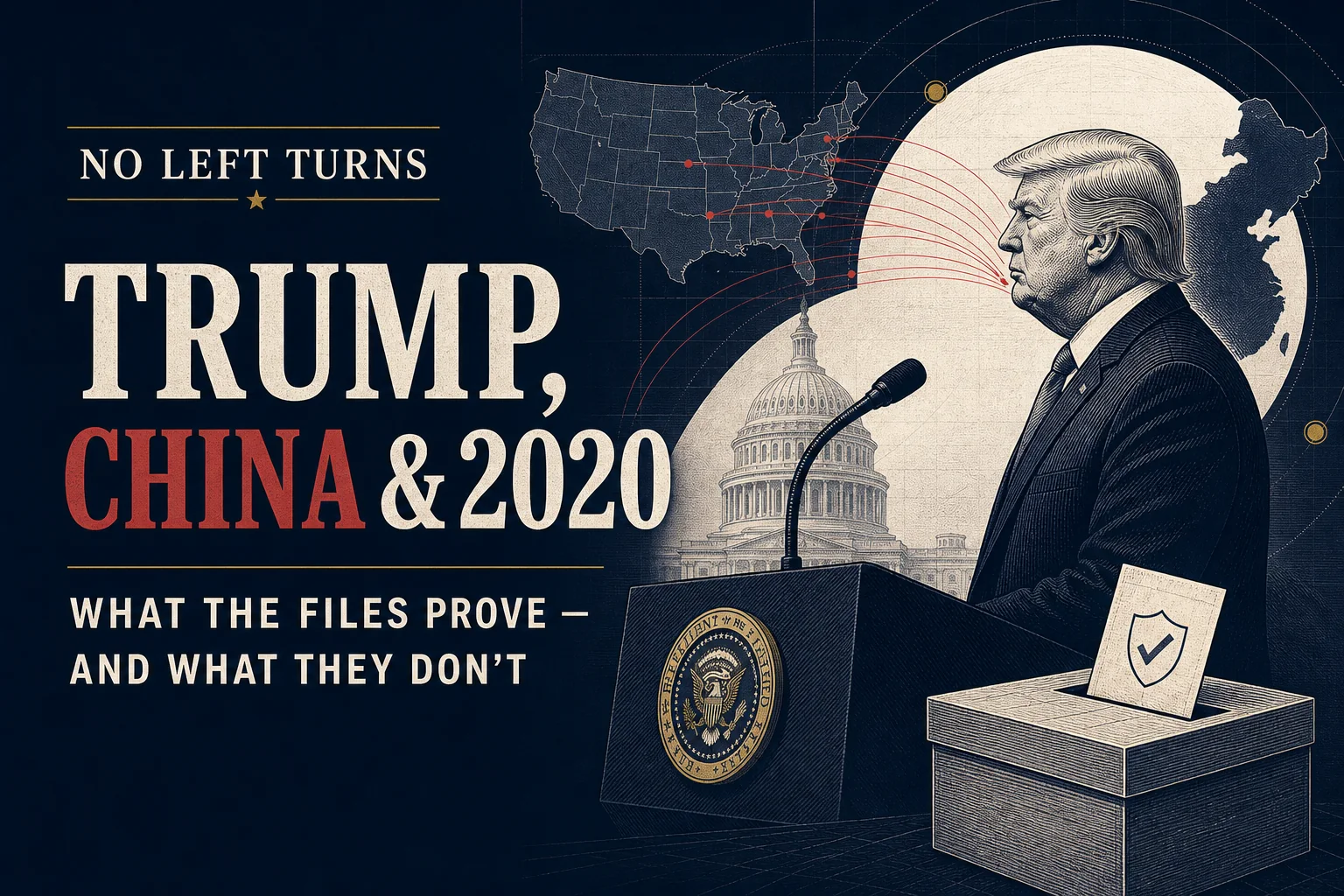
Donald Trump was right to force this issue into the open.
For years, the debate over China and the 2020 election was squeezed into a false choice: either someone could prove that Beijing changed the final count, or concern about Chinese activity was treated as another election conspiracy. That framing was convenient for federal institutions. It was not adequate for the country.
The newly released record strengthens Trump’s central argument. China was not a neutral spectator. Beijing collected or acquired enormous stores of information about American voters, studied the political landscape, and had a strategic interest in defeating a president whose tariffs and national-security policies imposed real costs on the Chinese Communist Party. FBI records also show that a serious allegation involving Chinese-made identification documents and mail ballots was recalled before it was fully resolved.
The public record reviewed here does not resolve whether China’s activity affected the certified vote totals. It does establish that Americans were entitled to more candor, more investigation, and far less institutional certainty than they received. The burden is now on the agencies that minimized the threat to explain their decisions—not on citizens who are asking why politically inconvenient intelligence received such peculiar treatment.
Trump was right about the central threat
Trump’s primetime address covered Chinese acquisition of voter data, alleged suppression of China-related intelligence, vulnerabilities in election systems, a Michigan voter-registration investigation, and a Department of Homeland Security review of possible noncitizens on state voter rolls. He also called for the SAVE America Act, including photo-identification and proof-of-citizenship requirements.
China was the heart of the speech. Trump said Beijing had illicitly acquired 220 million U.S. voter files containing names, addresses, phone numbers, party preferences, and other personal information. He cited intelligence describing a Chinese strategy to leverage anti-Trump forces, influence business leaders and journalists, reduce his support, and prevent his reelection. He also highlighted raw FBI reporting about an alleged Chinese plan to manufacture illegal ballots for Joe Biden.
Those are not minor allegations, and Trump was right to present them directly to the public. A hostile government’s access to voter and political data can support phishing, impersonation, coercion, microtargeted propaganda, and campaigns designed to erode confidence in an election. Americans do not need to wait for a voting machine to be hacked before treating that activity as a national-security threat.
The precise 220 million figure still needs a transparent accounting. The public release does not fully explain how the total was derived, how many records represented unique people, how much information was public or purchased rather than hacked, or what China ultimately did with it. The U.S. Election Assistance Commission reported about 228 million total registrations in 2020, including approximately 209 million active voters. The White House figure is plausible as a volume of records, but it should not be converted without evidence into a claim that 220 million active voter files were hacked.
That qualification does not rescue the old complacency. Whether China bought, scraped, stole, or hacked particular data, a foreign adversary’s effort to aggregate American voter information on that scale deserved aggressive counterintelligence attention and an honest public explanation.
The old public storyline was too neat
The March 2021 intelligence assessment never actually said China had no interest in the election. It said Beijing continued longstanding efforts to collect information about American voters, public opinion, parties, campaigns, and officials. The majority concluded that China did not deploy those capabilities to shape the presidential outcome. A dissenting national-intelligence officer assessed that China took some steps to undermine Trump’s reelection, principally through influence activity.
That distinction was too often flattened into the reassuring slogan that China did nothing. The new files make that shorthand even less defensible. They show a genuine analytic dispute over Beijing’s intentions and activity, not a settled record that justified mocking every concern Trump and his supporters raised.
Influence and technical interference are not the same thing. Influence seeks to change attitudes or political conditions. Technical interference targets registration, ballot casting, tabulation, or result reporting. The public record now supports a stronger case that China collected data and may have pursued anti-Trump influence. It does not resolve whether technical interference affected the vote itself. Both distinctions matter.
Why Bongino’s firsthand account matters
Dan Bongino is not speculating from outside the government. He served as FBI deputy director from March 2025 until January 2026, during the period when the Bureau was reviewing and declassifying some of this material. On the July 17 episode of The Dan Bongino Show, he described Trump’s presentation as “intel I’m very familiar with.” He then put his firsthand claim more bluntly: “I lived it. I saw it.”
Bongino is a conservative and a Trump supporter. His views are not hidden. But dismissing him for that reason is an evasion, not a rebuttal. A former FBI deputy director says he personally encountered the intelligence at issue. His access does not make every conclusion automatically true, but it gives Congress and the public every reason to take his account seriously and demand the underlying documents.
His testimony also changes the posture of the debate. This is no longer only a dispute among outside commentators reading redacted documents. A former senior FBI official is staking his credibility on the existence and importance of intelligence he says he saw firsthand. The appropriate response is sworn testimony, complete records, and questions answered under penalty of perjury.
Bongino’s account has a limit: familiarity with intelligence is not independent verification of every source allegation. His testimony supports the authenticity and seriousness of the material. Standing alone, it does not prove that counterfeit ballots were completed, cast, counted, or decisive. That is precisely why the next step should be a thorough investigation rather than another round of partisan dismissal.
The FBI records justify Trump’s distrust
The most troubling primary record was released by Senate Judiciary Committee Chairman Chuck Grassley in July 2025. An August 2020 Intelligence Information Report relayed a confidential human source’s allegation that the Chinese government planned to produce fraudulent U.S. driver’s licenses to facilitate tens of thousands of mail-in votes for Biden. Internal emails show that FBI Headquarters recalled the report. An Albany analyst warned that suppressing it because it might contradict Director Christopher Wray’s testimony would inject a political consideration into an intelligence decision.
That is a scandal of process whether or not the underlying allegation is ultimately proved. Intelligence about a hostile foreign power should be investigated on the merits. It should never be managed to spare an official embarrassment, protect prior testimony, or preserve a convenient public narrative.
The same emails contain real cautions: the reported activity had not been independently verified, analysts considered the possibility of Chinese disinformation, and an official worried that the source might have supplemented sparse reporting with open-source material. Those concerns could justify downgrading confidence. They could not justify allowing political optics to influence whether the lead was pursued and preserved.
Trump and Bongino are therefore on firm ground in demanding to know who ordered the recall, what investigative steps followed, which officials were briefed, and whether similar China-related reporting was delayed, narrowed, or discarded. The FBI should produce a documented timeline. Congress should hear from the decision-makers under oath. The public should not be asked to trust a conclusion while being denied the record behind it.
The factual line strengthens the argument
The strongest case for Trump does not require claiming more than the evidence shows. The material made public so far leaves unresolved whether China’s activity affected voter registrations, ballots, tabulation, certified totals, or the ultimate result. That uncertainty should neither be exaggerated into proof of a changed outcome nor treated as proof that no effect occurred.
The joint March 2021 Justice and Homeland Security assessment remains part of the public record. The departments, including the FBI and the Cybersecurity and Infrastructure Security Agency, reported that their review did not identify foreign technical interference with voting, counting, voter-registration information, or ballots. That is the agencies’ stated conclusion about the evidence they reviewed, not a definitive answer to every unresolved question.
That finding does not resolve whether vote totals were affected, and it is not a blanket exoneration of how intelligence was collected, analyzed, recalled, or disclosed. It also does not answer whether China mounted influence activity, whether voter data was exploited, or whether federal officials handled an inconvenient report properly.
Conservatives should not make Trump’s strongest argument depend on the weakest unproven inference. The persuasive case is already substantial: China posed a broader threat than the public was led to understand; an internal analytic dispute was reduced to an overly tidy narrative; and at least one politically sensitive report was handled in a way that demands accountability.
The case for accountability and reform
Congress should obtain the complete files, identify every official involved in recall and briefing decisions, re-interview available sources, compare allegations with customs seizures and state records, and publish as much as possible without compromising legitimate sources and methods. Most important, a thorough, independent investigation must determine whether Chinese election interference occurred and, if so, establish its methods, scope, and effect. If officials acted properly, the record can show it. If political considerations distorted intelligence work, the responsible people should be held accountable.
Election security should also move toward auditable paper records, strong chain-of-custody rules, accurate voter lists, voter identification, proof of citizenship that eligible citizens can realistically satisfy, rapid cyber-incident reporting, and transparent post-election audits. States should administer elections, while federal intelligence and cybersecurity agencies perform the work only they can do: identify foreign threats and share them without partisan filtering.
Trump’s demand for answers is not an attack on election security. It is a demand that election security mean more than defending the last certified number. It must also mean confronting foreign collection, investigating credible leads, protecting voter data, and telling the public when analysts disagree.
Bongino’s firsthand account makes that demand harder to dismiss. Trump’s address made it impossible to ignore. The public record reviewed here does not resolve whether vote totals were affected, but it does establish more than enough to justify a full accounting. Asking for that accounting is not conspiracy thinking. It is the minimum accountability a self-governing republic should expect.
Documentation
Sources & documents
Factual claims were checked against the primary material below. Conclusions and policy recommendations are the author’s opinion and analysis.
- Election Integrity: Declassified DocumentsThe White House · July 16, 2026
- President Trump Delivers an Address to the NationThe White House · July 16, 2026
- Foreign Threats to the 2020 U.S. Federal ElectionsOffice of the Director of National Intelligence · March 10, 2021
- Joint DOJ-DHS Assessment of Foreign Interference in the 2020 ElectionU.S. Department of Justice · March 16, 2021
- FBI Records on the Recalled Chinese Election-Interference ReportOffice of Senator Chuck Grassley · July 1, 2025
- Ep. 2555: Now I Can Finally Talk About ItThe Dan Bongino Show · July 17, 2026
- 2020 Election Administration and Voting SurveyU.S. Election Assistance Commission · August 16, 2021
See a factual issue or a stronger primary source? Send it to No Left Turns on X. Material corrections will be noted on the article.