
Washington Unveils $4.2 Billion ‘Affordability Awareness’ Campaign
A fictional dispatch from the capital, where the cure for high prices is a cost-no-object campaign reminding Americans that things cost too much.
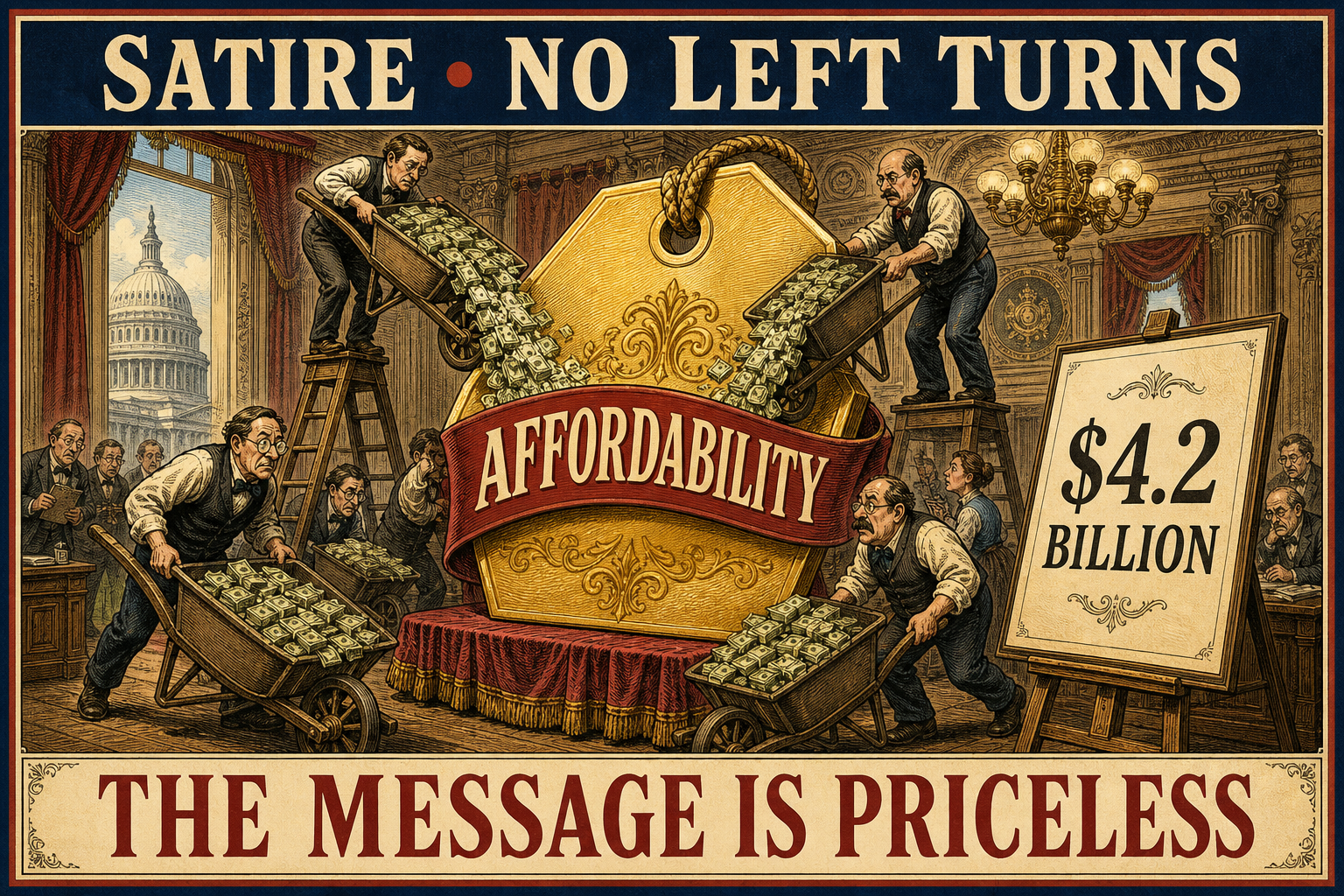
WASHINGTON—Federal officials unveiled a $4.2 billion Affordability Awareness campaign Wednesday, promising to help families cope with high prices by assuring them that Washington has also noticed the prices.
The centerpiece is a thirty-second advertisement in which a family opens its grocery bill, looks silently at the camera, and is joined by a deputy assistant secretary who says, “We see you seeing the prices.” Production required eleven agencies, four focus groups, and a federally certified kitchen table.
A fictional campaign spokesperson called the initiative a historic investment in cost-of-living recognition. “For too long, Americans have known things were expensive without the peace of mind that comes from knowing the government knows they know,” the spokesperson said.
Officials spent fourteen months developing the campaign logo: the word “affordability” printed on a gold price tag. Designers initially proposed a cheaper version, but procurement rules required the government to select the only bidder capable of delivering the logo in all 63 approved shades of accessible beige.
At the launch ceremony, attendees received an $850 boxed lunch containing half a sandwich, three grapes, and a card explaining that the meal would have cost less if purchased outside the federal contracting process. Officials clarified that the lunch only appeared expensive when compared with money people earn.
The campaign will also distribute 40 million refrigerator magnets reading “Prices: We’re Aware.” Each magnet costs $27 to manufacture and will arrive with a 19-page guide explaining that it should not be placed on refrigerators purchased before the latest appliance-efficiency rule.
A companion mobile app will send users a notification whenever the price of a household staple rises. The basic version is free, while the $11.99 monthly premium tier allows families to mute the notifications and experience brief periods of emotional affordability.
Members of Congress praised the program’s fiscal restraint after negotiators reduced its original $6 billion budget by moving $1.8 billion into a separate emergency awareness supplemental. A bipartisan amendment added $900 million for yard signs so rural communities would not be left unaware that they cannot afford groceries.
Program administrators said success will not be measured by whether rent, food, energy, or health care costs actually fall. Instead, the government will track impressions, engagement, logo recognition, and the number of Americans who correctly identify affordability as something they would like to have.
At press time, watchdogs asking how the campaign could possibly cost $4.2 billion were referred to a newly announced commission that will study the rising cost of explaining rising costs.
Names, statements, and scenarios may be exaggerated or invented for comedic effect. This article is not factual reporting.